Selasa, 14 Juli 2009

Windows 7: Not Done Yet, but Close


Microsoft gave an update on Windows 7 this week, outlining a timeline for the release of the upcoming operating system to manufacturers. The company noted that you shouldn't "believe everything you read on the Internet" and proceeded to set the record straight.

Microsoft's Windows Communications Manager Brandon LeBlanc yesterday took to the official Windows 7 blog, in an attempt to quell rumors that the company has already sent off the finished Windows 7 code to its manufacturing team.


Release to Manufacturing, or RTM, means that the code is oh-so-close to being finished for product release and moves on to the next step - which includes testing and building images for new PCs, according to LeBlanc. "RTM is essentially the final ‘stage' of engineering for Windows 7 before it hits the market at General Availability (GA)," he wrote.

While RTM hasn't happened yet, Microsoft is getting very close to manufacturing and packing millions of its highly anticipated Windows 7 disks for shipment to stores near you, where it will land on October 22.

So what's next as Windows 7 approaches?

One other key step to be completed is getting Windows 7 ready for use in nations around the globe by finishing its availability in many other languages besides English.

For the RTM to move to the next step, Microsoft wants to have those other versions that support different languages completely finished, LeBlanc said.

Another stepping stone to RTM, according to the blog, is getting all of its business partners up to speed, or what LeBlanc calls "global readiness," before the official launch of Windows 7 happens.

That way computer makers, retailers, IT consultants and the rest are all ready with what they need to know to sell, install, service and support computers with the new operating system.

Also still to come is the point where the last stage of final testing and step-by-step validation can be done before the actual Windows 7 DVD installation disks and images are readied for shipment to retailers and PC makers before October 22's release date.

When an earlier pre-release version of Windows 7 was recently leaked online, many tech-watchers thought that meant that Windows 7 was already at the RTM stage, LeBlanc wrote. But that's not the case, he explains.

"This process takes time," LeBlanc wrote. "Just because a single build may have ‘leaked' it does not signal the completion of a milestone such as RTM. As always, don't believe everything that you read on the Internet - except this post ;-)."

When Windows 7 does finally reach the RTM stage, that milestone will be announced on the Windows 7 blog right away, LeBlanc wrote. "Until that happens, any builds you are likely to see on the Web are either not the final bits or are laced with malicious code."

You have been warned.

So are you ready?

While you're waiting, there's plenty for you to do.

You can check out the look of the new Windows 7 packaging that will be on store shelves Oct. 22, and you can start going over your PCs with Microsoft's online tools to check if your PC hardware is up to the task of the new Windows 7.

Can't wait to see more?

Then take the online Microsoft tour of Windows 7 to see many of the new features that you'll soon be using.

In the meantime, relax, go out for a walk, hear the birds and visit with your friends and families.

Because when Oct. 22 rolls around, you'll likely be sitting for hours in front of your PC, backing up data files, cleaning out the crud, upgrading some hardware, then installing Windows 7 and all of your applications.

Take advantage of the free time you have today and enjoy it. It's going to be a long autumn of upgrading!
Todd R. Weiss

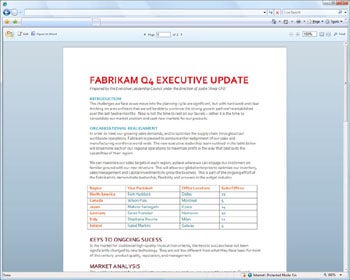
Office Web Apps: Five Questions Releasing its paid software onto the Web for free is a bold move for Microsoft. Here's what we want to know.


Microsoft's upcoming Office 2010 is news alone, but what really excited the tech world was the announcement of a free online version of the software, called Office Web Apps. The company already offers a bundle of cloud software over Windows Live -- including mail, storage, and blogging tools -- but taking its paid software onto the free, online world is a bold move. That raises some questions:
How, exactly, will Office Web Apps differ from Office 2010?

Microsoft is fuzzy on what will be different about Office Web Apps. The offline software will be more robust by comparison, but it's not clear how it'll be better, aside from the obvious advantage of not needing the Net. Using Word as an example, basic editing and spell check are enough for many tasks, and they'll be included. What about more advanced features like tables and track changes? Microsoft could very well clip one or two crucial features as a lure to the paid software, but we won't know for sure until a side-by-side comparison emerges.

How free is free?

The idea behind free Office Web Apps is to drive users toward Microsoft's money-making online services, such as Bing, but are there other strategies at work? What are we looking at for advertisements, and will Microsoft ever suggest that users "upgrade" to the paid software? Will people who pay for Office 2010 get additional features online? Inevitably, some cannibalization of the paid software will occur. Microsoft's response should be interesting.

Is there an App for that?

We heard rumblings of a Microsoft Office iPhone App back in April, but so far, nothing's coming. That makes me curious how Office Web Apps will function on a smartphone, or whether Microsoft will instead opt for a paid app. Keep in mind that Google Docs already offers mobile access, so if Microsoft wants to be competitive on all fronts, it'll follow suit.

Will full compatibility ever happen?

The Web version of Office 2010 will be compatible with Internet Explorer, Firefox, and Safari. That leaves Opera and, more notably, Google's Chrome out in the cold. As a tactic, that's understandable, given that Chrome drives more people to Google searches and Microsoft is trying to pull them away. But it's not clear whether that's the intent. If not, will we see Chrome support in the future?

Will Office 2010 play well with Windows Live?

If you have a Windows Live account, do us a favor and check out the home page right now. It's not the cleanest site around -- so how clean and friendly will Windows Live become when hundreds of millions of users storm the gates, looking to process words? It's pleasing to know that Office Web Apps will integrate with Microsoft's SkyDrive online storage, but will users be able to import photo albums or e-mail documents directly from the Word processor? Microsoft has the opportunity to create a seamless service across all of Windows Live. Here's hoping the company doesn't blow it.

Kamis, 09 Juli 2009

British scientists claim to create human sperm


LONDON – British scientists claimed Wednesday to have created human sperm from embryonic stem cells for the first time, an accomplishment they say may someday help infertile men father children.

The technique could in 10 years allow researchers to use the basic knowledge of how sperm develop to design treatments to enable infertile men the chance to have biological children, said lead researcher Karim Nayernia, of Newcastle University, whose team earlier produced baby mice from sperm derived in a similar way.

The research, published in the journal Stem Cells and Development, was conducted by scientists at Newcastle and the NorthEast England Stem Cell Institute.

Stem cells can become any cell in the body, and scientists have previously turned them into a variety of new entities, including cells from the brain, pancreas, heart and blood vessels.

Some experts challenged the research, saying they weren't convinced Nayernia and his colleagues had actually produced sperm cells. Several critics also said the sperm cells they created were clearly abnormal.

"I am unconvinced from the data presented in this paper that the cells produced by Professor Nayernia's group from embryonic stem cells can be accurately called 'spermatazoa," said Allan Pacey, a senior lecturer in andrology at the University of Sheffield.

Pacey said in a statement that the sperm created by Nayernia did not have the specific shape, movement and function of real sperm.

Azim Surani, a professor of physiology and reproduction at the University of Cambridge said the sperm produced by the Newcastle team were "a long way from being authentic sperm cells."

Nayernia said the cells "showed all the characteristics of sperm," but his group's intention was simply to "open up new avenues of research" with their early findings, rather than using the sperm to fertilize eggs.

Robin Lovell-Badge, a stem cell expert at the National Institute of Medical Research said that despite the questions raised, Nayernia and colleagues may have made some progress in obtaining human sperm from embryonic cells.

Nayernia said creating embryos from lab-manufactured sperm is banned by British law.

He said they only plan to produce sperm to study the reasons behind infertility, and will not fertilize any eggs.

Some lawmakers said provisions should be made to allow sperm derived from stem cells to be tested as part of potential fertility treatments.

__

AP Science Writer Malcolm Ritter contributed to this report from New York.

Bombings in Mosul, Baghdad kill at least 41


BAGHDAD – Two suicide bombers on Thursday killed at least 34 people and injured 70 in an attack on the home of an anti-terrorism officer in northern Iraq, while three roadside bombs in Baghdad killed seven others, authorities said.

The attacks came one day after car bombs in two Shiite villages near the northern Iraqi city of Mosul killed 16 civilians and injured more than two dozen, in a surge of violence in Iraq's troubled north following the withdrawal of U.S. combat forces from cities to bases outside urban centers at the end of June.


Iraq is trying to build on security gains made in the past two years, though political reconciliation among the country's factions remains a troubled process and there is concern that insurgent attacks could trigger a slide back into sectarian violence.

Maj. Gen. Khalid al-Hamadani, the police chief of the northern Ninevah province, said the first bomber, wearing a police uniform and carrying a radio and a pistol, knocked on the door of a police officer who works as an investigator in the anti-terrorism police department in Tal Afar city.

When the officer opened the door around 6:30 a.m., the bomber detonated his explosive belt, killing the officer, his wife and son, al-Hamadani said. As people gathered near the scene, another suicide bomber detonated his explosives belt.

At about 7:30 a.m. in Baghdad, two roadside bombs exploded near an outdoor market in the Shiite district of Sadr City, killing six and injuring 31, said Maj. Gen. Qassim al-Mousawi, spokesman for the city's operations command center. Explosives experts defused a third bomb in the area.

Hassan Abdullah, a 32-year-old vegetable salesman, said he heard the first blast and went to see what was happening when a second bomb hidden in trash about 100 meters away exploded. He said he fell to the ground and was taken to a hospital with hand and leg injuries.

In the Karrada district of central Baghdad, one civilian was killed and five were injured in a roadside bomb attack on the convoy of Central Bank Gov. Sinan al-Shibibi, a police officer said on condition of anonymity because he was not authorized to speak to the media. Three of the injured were guards of the governor, who himself was unharmed.

The bomb hit a vehicle carrying guards at the rear of the convoy as well as a nearby civilian car.

Also in Baghdad, a bomb concealed in a bicycle parked at a market in the Shiite-dominated area of Shurta al-Rabeaa exploded, wounding two people and damaging three shops, police said. Three other people were wounded, when a bomb exploded in a minibus in southwestern Baghdad.

___

Associated Press Writer Hamid Ahmed in Baghdad contributed to this report.